- From Palaces to Pilgrimages: India Pitches Luxury and Serenity to Korean Tourists
- Korea Advances Energy Security Ties with Japan and U.S. at Inaugural IPEM in Tokyo
- President Lee Visits Traditional Markets in Cheongju and Changwon, Pledges Support for Local Commerce
- Korea Imposes Maximum Prices on Petroleum Products Amid Middle East Supply Concerns
- Indonesia, France, and the New Seoul Consensus: Lee Jae Myung's Diplomatic Double Header
- Korea Joins Unprecedented IEA Collective Action as Global Oil Supply Crisis Deepens
- 2026 Sanjo Festival Opens April 2 at Seoul Donhwamun Traditional Theater
- A New Constitutional Model for Kazakhstan’s Future
- First Lady Kim Hye Kyung Champions Education and Global Solidarity on World Women's Day
-
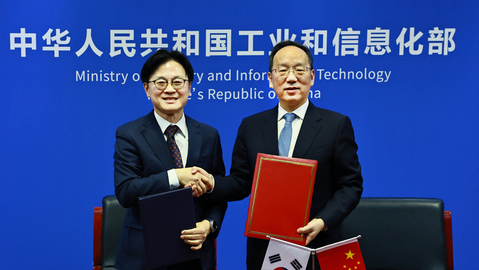
Korea and China Reboot Industrial Ties in Beijing Ministerial Meetings
MOTIR Minister Kim Jung-Kwan holds back-to-back talks with Chinese counterparts on supply chain stability, semiconductors, and green industry cooperation
The Ministry of Trade, Industry and Resources (MOTIR) announced on March 19 that MOTIR Minister JK (Jung-Kwan) Kim visited Beijing on March 18, 2026, and held successive Korea–China ministerial meetings on commerce and industry. Minister Kim first met with Wang Wentao, China’s Minister of Commerce, and agreed to focus on implementing the agreements reached by the two leaders and stabilizing supply chains amid rapid shifts in the global trade environment. In the event of logistics delays or raw material shortages, the two countries will immediately activate communication channels, including the supply chain hotline, and coordinate a joint response. For critical items such as rare earths and permanent magnets, they will use the export control dialogue and expedited and standardized licensing arrangements to improve predictability in bilateral supply chains. On trade, the two ministers discussed ways to expand bilateral cooperation into new areas, including consumer goods, by leveraging China’s drive to boost domestic demand. They agreed to increase business engagement through exchange events and trade fairs with China’s major economic provinces. The Korea–China FTA Joint Committee will be convened in the first half of 2026 to work toward practical outcomes in the services and investment negotiations. The two sides also recognized the need for effective measures to protect Korean music, films, and other intellectual property in China, including through the resumption of the intellectual property implementation committee. Minister Kim then held the fifth Korea–China Industrial Ministers’ Meeting with Li Lecheng, China’s Minister of Industry and Information Technology. It was the first Korea–China industrial ministerial meeting in four years since the virtual meeting in January 2022, and the first in-person meeting in eight years since the Seoul meeting in May 2018. Recognizing how the structure of Korea–China industrial cooperation has evolved, the two ministers agreed that future cooperation should move toward a more equal and mutually beneficial footing. They will deepen cooperation in advanced sectors such as semiconductors and batteries, while exploring new opportunities in the green transition of industry and the silver economy. The two sides also discussed ways to stabilize the tightly interconnected industrial and supply chains in the battery sector. In semiconductors, which account for 26 percent of bilateral trade, they will step up policy communication and actively support the smooth operation of Korean semiconductor plants in China. The two sides acknowledged the need for cooperation on the green transition of industry and the silver economy in response to the common challenges of climate change and population aging. To that end, they will exchange technologies and experience and promote cooperation between companies and research institutions. They will also share experience in building industrial supply chain data platforms as a digital foundation for the green transition of industry. Minister Kim stressed that although competition between the two countries’ industrial sectors has intensified, the mutual benefits of cooperation remain unchanged. He called for continued efforts to identify promising areas for cooperation and address shared challenges together.
-
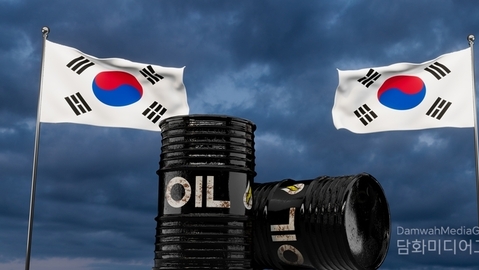
Korea Secures UAE Oil Lifeline as Hormuz Crisis Deepens
Presidential Special Envoy confirms 24 million barrels in emergency crude imports and priority supply pledge from Abu Dhabi amid Middle East tensions
On March 18, Cheong Wa Dae released the following statement from the Presidential Special Envoy for Strategic Economic Cooperation: I will now present the results of this visit to the UAE, undertaken together with the special envoy delegation from the Ministry of Foreign Affairs, the Ministry of Trade, Industry and Resources, and other participating ministries. Amid the ongoing crisis in the Middle East, the delegation held discussions on ways to further strengthen trust with the UAE — a longstanding friend and key partner nation — and to explore concrete avenues for cooperation in times of crisis. We first called on UAE President Mohamed bin Zayed Al Nahyan, conveying President Lee Jae Myung's personal letter, which expressed deep concern over the current situation in the Middle East along with heartfelt sympathy and solidarity with the people of the UAE. Energy Cooperation: Key Outcomes Against the backdrop of a global emergency in crude oil supply and demand, the UAE has pledged to supply South Korea with crude oil on a priority basis above all other nations. In direct terms, President Mohamed bin Zayed gave an unequivocal commitment: Korea is "Number 1 Priority." The Strait of Hormuz is currently under effective blockade. As approximately 70 percent of the crude oil Korea imports passes through the strait, securing alternative supply routes outside the Hormuz corridor has become an urgent priority in addressing the current energy crisis. To this end, the delegation met with President Mohamed bin Zayed, Khaldoon Khalifa Al Mubarak — Director General of the Abu Dhabi Executive Affairs Authority and UAE Special Envoy for Korea — and Sultan Al Jaber, UAE Minister of Industry and Advanced Technology and CEO of ADNOC, reaching agreement that Korea may conduct emergency crude oil purchases from the UAE at any time as the situation in the Middle East develops. As a result, a total of 18 million barrels of crude oil has been confirmed for emergency import through multiple supply channels. Specifically, three UAE-flagged vessels will deliver 6 million barrels, with an additional 12 million barrels to follow aboard six Korean-flagged vessels — bringing the total to 18 million barrels. A vessel carrying naphtha is additionally en route to Korea at this time. Including the 6 million barrels received in the previous supply arrangement, Korea will have received a total of 24 million barrels in emergency imports from the UAE. This energy agreement is expected to contribute significantly to stabilizing the crude oil supply-and-demand situation. The two countries also agreed to strengthen cooperation on long-term energy supply in preparation for potential further disruptions to supply chains, in addition to addressing immediate-term needs. To this end, the two sides reached an agreement to sign a Memorandum of Understanding on crude oil supply chain cooperation — covering the exploration of alternative supply routes, among other provisions — with the signing expected to take place in the near future. Consular and Humanitarian Cooperation The delegation expressed its sincere gratitude to President Mohamed bin Zayed for his extensive support in facilitating the safe and timely return of Korean nationals, and formally requested his continued attention to the welfare of Korean citizens still residing in the UAE. From the very outset of the Middle East crisis, real-time information sharing and coordination of necessary measures were conducted through a dedicated hotline between myself and Director General Khaldoon. As a result, beginning March 6 — one week into the crisis — the UAE promptly lifted its airspace closure, with UAE-flag carriers resuming direct flights to Korea from Dubai and Abu Dhabi. On March 8 in particular, an Etihad Airways charter flight was arranged, enabling swift repatriation assistance. Of the approximately 3,500 short-term Korean visitors in the UAE at the time, roughly 3,000 have since returned home safely. Closing Remarks This visit reaffirmed that Korea and the UAE — bound by a Special Strategic Partnership — are true friends who stand by one another in difficult times. Both sides also shared the view that, as the situation in the Middle East normalizes on the basis of the UAE's resilience and leadership, the bilateral relationship will emerge stronger than before. This concludes the report on the UAE visit. ---------------------------------------------------------------- (Press Release translated by AI, edited by David Kendall)
-
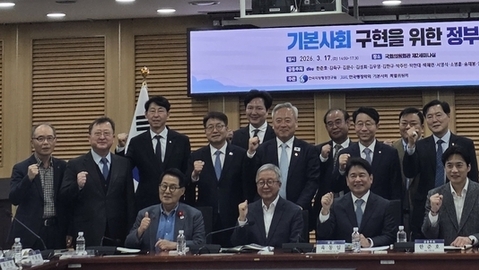
From Policy to Practice: Korea Seminar Explores Basic Society Roadmap
National Assembly seminar calls for coordinated central-local framework to guarantee basic livelihoods
On March 17, the Korea Research Institute for Local Administration (KRILA) held a policy seminar titled "The Role of the Government and Local Governments in Realizing a Basic Society" in the National Assembly Members' Office Building in Seoul. The seminar was organized to explore policy directions for guaranteeing the basic livelihoods of citizens amid sweeping structural changes in society — including the rise of AI, low birthrates, an aging population, regional depopulation, and growing polarization — and to discuss the division of roles and cooperation between the central government and local governments in the process of realizing a Basic Society. The event was co-hosted by the following members of the National Assembly: Kang Deuk-gu (Anyang Manan, Gyeonggi), Kim Moon-soo (Suncheon·Gwangyang·Gokseong·Gurye-gap, South Jeolla), Kim Sung-hoe (Goyang-gap, Gyeonggi), Kim Woo-young (Eunpyeong-eul, Seoul), Kim Han-gyu (Jeju City-eul, Jeju), Park Joo-min (Eunpyeong-gap, Seoul), Park Chan-dae (Yeonsu-gap, Incheon), Baek Hye-ryeon (Suwon-eul, Gyeonggi), Seo Young-seok (Bucheon-gap, Gyeonggi), So Byeong-hun (Gwangju-gap, Gyeonggi), Song Jae-bong (Cheongwon, Cheongju, North Chungcheong), Yeom Tae-young (Suwon-mu, Gyeonggi), Yun Jong-gun (Anseong, Gyeonggi), Lee Geon-tae (Bucheon-byeong, Gyeonggi), Lee Jae-gang (Uijeongbu-eul, Gyeonggi), Lee Hun-gi (Namdong-eul, Incheon), Jo Gye-won (Yeosu-eul, South Jeolla), Jo Jeong-sik (Siheung-eul, Gyeonggi), Chu Mi-ae (Hanam-gap, Gyeonggi), and Han Jun-ho (Goyang-eul, Gyeonggi). The program opened with welcoming remarks by Rep. Han Jun-ho, followed by a welcome address from KRILA President Yuk Dong-il, and congratulatory remarks from Kang Nam-hoon, Vice Chairman of the Basic Society Committee, and Seong Si-gyeong, President of the Korean Association for Public Administration. Professor Emeritus Choi Heung-seok of Korea University then delivered a presentation on "The Necessity of a Basic Society and its Implementation Strategy," followed by a presentation by KRILA Senior Research Fellow Ko Gyeong-hun on "The Role of Local Governments in Realizing a Basic Society." A panel discussion involving experts from academia and research institutions followed, with a range of opinions offered on the policy direction and practical tasks related to Basic Society initiatives. Rep. Han Jun-ho remarked that "the advancement of AI technology and structural changes in society have heightened the need for a new social safety net to guarantee the basic livelihoods of citizens," adding that "this is an important juncture for policy discussions on a Basic Society." He further stressed that "addressing structural challenges such as polarization and regional depopulation requires a clear definition of roles and cooperation between the central government and local governments," and that "a collaborative policy framework — in which the center establishes the institutional foundation while local governments implement policy on the ground where residents live — is essential." In his welcome address, KRILA President Yuk stated that "a Basic Society is more than a policy slogan; it is a vital challenge of our times, pointing the way forward for our society," and that "we are at a moment when serious policy reflection is needed on how to guarantee the basic livelihoods of citizens amid structural crises such as low birthrates, an aging population, and regional depopulation." He added that "realizing a Basic Society requires not only the institutional foundation provided by the central government, but also the crucial role of local governments, which implement policy closest to where residents actually live," and that "real outcomes can only be achieved when the center and localities collaborate in designing and executing policy." KRILA has announced that it will continue, as a policy research institute bridging central and local government, to pursue research on decentralization, balanced growth, and resident-centered, locally driven administrative innovation, while offering effective policy alternatives in a changing policy environment. About the Korea Research Institute for Local Administration (KRILA) Established in 1984, KRILA is a policy research institution that leads the development of national policy tasks related to local autonomy and the formulation of policies and systems, while providing vision, advisory services, management diagnostics, and consulting to local governments. As a pivotal institution advancing local self-governance, KRILA has contributed to the development of local administrative governance in Korea through extensive research, and plays a central role in building the academic foundation for decentralization and balanced regional development. ----------------------------------------------------------------- (Press Release translated by AI, edited by David Kendall)